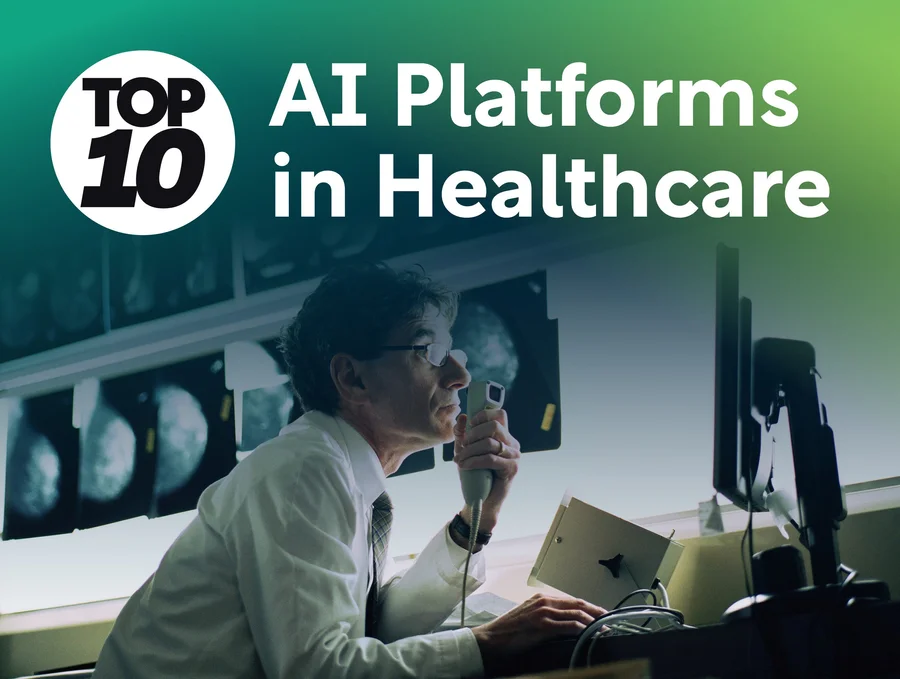
AI platforms are becoming central to healthcare as providers seek faster insight from complex clinical data.
By embedding intelligence into everyday workflows, they help clinicians make better decisions, reduce pressure on overstretched systems and focus more time on patient care.
As costs rise and expectations increase, AI platforms are shaping a more resilient healthcare model that is more predictive and personalised than ever before.
Here, AI Magazine takes a look at the Top 10 AI platforms being used in the healthcare sector.
10. Butterfly Network
Headquarters: Massachusetts, USA
CEO: Joseph DeVivo
Year founded: 2011
Number of Employees: ~200

Butterfly Network applies artificial intelligence to portable ultrasound, combining semiconductor-based hardware with cloud software and guided imaging tools.
Its AI capabilities support image optimisation, automated measurements and clinical decision support at the point of care.
While the platform is more hardware-led than others on this list, it plays a growing role in expanding access to diagnostic imaging in primary, emergency and remote healthcare settings.
9. Caption AI (Caption Health, part of GE HealthCare)
Headquarters: California, USA
CEO: Peter J. Arduini (GE Healthcare)
Year founded: 2013

Caption AI delivers AI-guided ultrasound technology that enables clinicians with limited imaging experience to capture high-quality diagnostic images.
Integrated into GE HealthCare’s wider ecosystem, the platform uses real-time guidance and automated workflows to improve consistency and access to care.
Its focused scope limits platform breadth, but enterprise deployment through GE Healthcare gives it significant clinical reach.
8. PathAI
Headquarters: Massachusetts, USA
CEO: Andy Beck
Year founded: 2016
Number of Employees: ~300

PathAI is a specialist AI platform focused on digital pathology, applying machine learning to improve diagnostic accuracy and workflow efficiency.
Its technology supports pathologists and life sciences organisations through image analysis, disease detection and biomarker discovery.
While narrower in scope than enterprise-wide platforms, PathAI plays a critical role in oncology diagnostics and drug development.
7. Merative
Headquarters: Michigan, USA
CEO: Gerry McCarthy
Year founded: 2022
Number of Employees: ~3,000

Merative provides healthcare data, analytics and AI solutions to payers, providers and life sciences organisations.
Formed from IBM Watson Health assets, its platforms support population health, clinical decision-making and outcomes research.
While less clinician-facing than newer AI entrants, Merative remains a significant enterprise analytics partner across global healthcare systems.
6. Truveta
Headquarters: Washington, USA
CEO: Terry Myerson
Year founded: 2020
Number of Employees: ~400

Truveta operates a large-scale real-world data platform built on de-identified clinical data from health systems.
Using AI and advanced analytics, it supports research, population health insights and therapy development.
Its strength lies in longitudinal data depth and system-level collaboration rather than frontline clinical tools.
5. Tempus
Headquarters: Illinois, USA
CEO: Eric Lefkofsky
Year founded: 2015
Number of Employees: 2,300+

Tempus is a precision medicine platform applying AI to clinical and molecular data, with a strong focus on oncology.
Its technology supports personalised treatment decisions, clinical trial matching and research insights.
By combining genomics, imaging and real-world data, Tempus has established itself as a leader in data-driven medicine.
4. Aidoc
Headquarters: Tel Aviv, Israel
CEO: Elad Walach
Year founded: 2016
Number of Employees: 500+

Aidoc delivers an enterprise AI platform for medical imaging, enabling health systems to deploy, manage and scale multiple AI algorithms across clinical workflows.
Its orchestration layer supports prioritisation, triage and clinical collaboration beyond radiology.
Aidoc stands out for its mature governance, integration and real-world clinical adoption.
3. Google Cloud Healthcare
Headquarters: California, USA
CEO: Thomas Kurian
Year founded: 2008
Number of Employees: 50,000+

Google Cloud Healthcare offers an AI-native platform built around its Healthcare API and Healthcare Data Engine.
It enables interoperability, population health analytics and advanced machine learning across clinical and research data.
Backed by Google’s AI capabilities, the platform is particularly strong in large-scale analytics and life sciences applications.
2. AWS HealthLake
Headquarters: Washington, USA
CEO: Matt Garman
Year founded: 2006
Number of Employees: 125,000+

AWS HealthLake is a fully managed health data platform designed to store, transform and analyse clinical data at scale using AI and machine learning.
Built on FHIR standards, it underpins countless healthcare AI applications globally.
Its strength lies in flexibility, interoperability and deep integration with the wider AWS ecosystem, making it a foundational platform for digital health innovation.
1. Microsoft Dragon Copilot
Headquarters: Washington, USA
CEO: Satya Nadella
Year founded: 1975
Number of Employees: 220,000+

Microsoft Dragon Copilot represents the most advanced clinician-facing AI platform in healthcare today.
Combining ambient clinical intelligence, Gen AI and workflow automation, it reduces administrative burden while improving documentation quality and care delivery.
Embedded within Microsoft’s broader healthcare and cloud ecosystem, the platform is rapidly becoming central to everyday clinical practice at enterprise scale.