Synthetic data tools are increasingly important, allowing organisations to develop, test and train AI systems without relying on sensitive or scarce real-world data.
By generating realistic datasets at scale, these tools help reduce privacy risks, improve model performance and accelerate innovation across regulated and data-poor industries.
As AI adoption grows, synthetic data tools also support compliance, enable safer experimentation and ensure organisations can innovate responsibly while maintaining trust and transparency at scale globally.
Here, AI Magazine takes a look at the leading synthetic data tools available on the market.
10. SDV
Headquarters: Open source, global community
CEO: Kalyan Veeramachaneni
Year Founded: 2019
Number of Employees: N/A

Synthetic Data Vault is an open-source framework designed to help data scientists generate high-quality synthetic tabular data. It supports single-table and multi-table relational datasets and includes built-in evaluation tools to measure statistical fidelity and privacy risk. SDV is widely used for experimentation, academic research and early-stage AI development where flexibility and transparency are priorities.
9. Duality AI
Headquarters: US
CEO: Michael Taylor
Year Founded: 2020
Number of Employees: ~50

Duality AI focuses on synthetic data generation through digital twins, enabling realistic simulation of physical environments. Its platform allows organisations to model complex systems and generate sensor-rich datasets for AI training and validation. The tool is particularly relevant for robotics, defence and industrial AI use cases where real-world data is limited or costly to collect.
8. DataGen
Headquarters: Tel Aviv, Israel
CEO: Ofir Chakon
Year Founded: 2018
Number of Employees: ~100
DataGen specialises in high-fidelity synthetic data for computer vision and multimodal AI models. Its platform generates diverse, annotated datasets at scale, supporting use cases across retail, robotics and autonomous systems. By reducing reliance on real-world data collection, DataGen helps teams accelerate model development while improving dataset diversity and robustness.
7. Parallel Domain
Headquarters: Palo Alto, US
CEO: Kevin McNamara
Year Founded: 2017
Number of Employees: ~70

Parallel Domain provides simulation-based synthetic data for training and validating perception models. Its platform generates labelled camera, lidar and radar data for autonomous driving and robotics applications. By enabling edge-case scenario creation and sensor customisation, Parallel Domain helps AI teams improve model safety, accuracy and performance without extensive real-world testing.
6. Delphix
Headquarters: Lehi, Utah, US
CEO: Jed Ayres
Year Founded: 2007
Number of Employees: ~600

Delphix integrates synthetic data generation into its broader data management and masking platform. It enables enterprises to create compliant, realistic datasets for testing, analytics and AI development while protecting sensitive information. Delphix is widely adopted in regulated industries where data privacy, governance and speed of delivery are critical.
5. Gretel.ai
Headquarters: San Diego, US
CEO: Ali Golshan
Year Founded: 2019
Number of Employees: ~80

Gretel.ai offers developer-focused synthetic data tools for structured data and text-based AI models. Its APIs allow teams to generate privacy-preserving datasets that maintain statistical accuracy while reducing exposure to sensitive information. Gretel.ai is commonly used to support machine learning experimentation, data sharing and responsible AI development.
4. K2view
Headquarters: Yokneam, Israel
CEO: Ronen Schwartz
Year Founded: 2009
Number of Employees: ~150
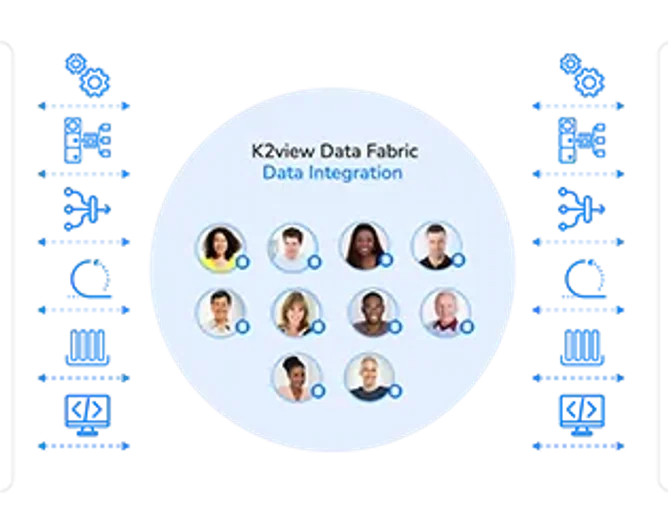
K2view delivers enterprise-grade synthetic data through a business-entity-driven platform that preserves complex relationships across systems. Its approach supports large-scale test data management, data masking and AI training use cases. K2view is particularly effective in complex IT environments such as banking, telecoms and healthcare.
3. MOSTLY AI
Headquarters: Vienna, Austria
CEO: Lukas Andre-Folgmann
Year Founded: 2017
Number of Employees: ~70

MOSTLY AI provides automated synthetic data generation for structured and text data with strong privacy guarantees. Its platform is designed to help organisations unlock sensitive datasets for AI development, analytics and data sharing. MOSTLY AI is widely recognised for combining ease of use with robust statistical accuracy and regulatory compliance.
2. Tonic.ai
Headquarters: San Francisco, US
CEO: Ian Coe
Year Founded: 2018
Number of Employees: ~120

Tonic.ai delivers realistic synthetic data for software testing and AI development, with a strong focus on usability and speed. Its platform allows teams to rapidly generate high-fidelity datasets that mirror production data while maintaining privacy. Tonic.ai is particularly popular with engineering teams seeking to accelerate development cycles without compromising security or compliance.
1. Nvidia NeMo
Headquarters: Santa Clara, US
CEO: Jensen Huang
Year Founded: 1993
Number of Employees: ~26,000

Nvidia NeMo sits at the top of the list due to its ability to combine synthetic data generation with large-scale AI model development. As part of Nvidia’s enterprise AI stack, NeMo supports the creation of synthetic datasets for conversational, multimodal and agentic AI systems. Its tight integration with Nvidia’s infrastructure makes it a powerful tool for organisations deploying AI at scale.